
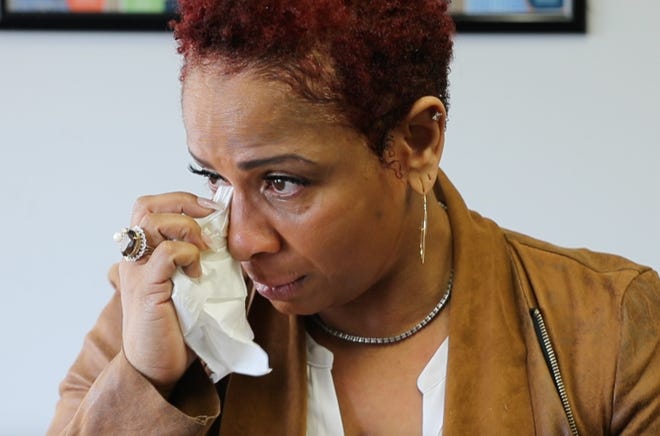
Carlette Duffy felt both vindicated and excited. Both relieved and angry.
For months, she suspected she had been low-balled on two home appraisals because she’s Black. She decided to put that suspicion to the test and asked a white family friend to stand in for her during an appraisal.
Her home’s value suddenly shot up. A lot.
During the early months of the coronavirus pandemic last year, the first two appraisers who visited her home in the historic Flanner House Homes neighborhood, just west of downtown, valued it at $125,000 and $110,000, respectively.
But that third appraisal went differently.
To get that one, Duffy, who is African American, communicated with the appraiser strictly via email, stripped her home of all signs of her racial and cultural identity and had the white husband of a friend stand in for her during the appraiser’s visit.
The home’s new value: $259,000.
“I had to go through all of that just to say that I was right and that this is what’s happening,” she said. “This is real.”
Now she wants justice. Along with the Fair Housing Center of Central Indiana, Duffy has filed fair housing complaints against the mortgage lenders and appraisers she accuses of undervaluing her home because of her race.
Housing experts and historians say residential real estate has been historically marred by discrimination. Across the nation, homes owned by Black Americans are significantly undervalued next to homes in comparable white neighborhoods, according to a study by Brookings.
Andre Perry, a senior fellow for the Brookings Metropolitan Policy Program who studies housing discrimination, said anecdotal evidence of housing discrimination can be found around the country.
“It’s almost when people see Black neighborhoods, they see twice as much crime than there actually is. They see worse education than there actually is,” Perry said. “I think this is what’s happening when appraisers, lenders, real estate agents see Blackness. They devalue the asset. They devalue the property.”
Read More:What to do if you suspect discrimination in home appraisals
The complaints
Duffy and the Fair Housing Center of Central Indiana filed the complaints with the U.S. Department of Housing and Urban Development. She’s asking for the federal agency to investigate the appraisals.
Respondents in the complaints include Indianapolis-based appraiser Tim Boston, appraiser Jeffrey Pierce, CityWide Home Loans and employee Craig Hodges, lender Freedom Mortgage and two of the company’s employees.
The complaints alleges they violated fair housing laws by allowing race and color to impact their appraisals of her home and their lending practices. The appraisers, the complaints said, purposely pulled comps that were unfair and racially motivated.
Appraiser Tim Boston denied the allegations.
“My appraisal reports are data-driven. I could care less about culture or sexual orientation,” he said. “It’s all about bricks and sticks and dirt.”
The remaining respondents could not be reached by IndyStar.
Red flags in the wording
When Duffy sought the first appraisal on her home, she didn’t do it with the intention of selling the house.
Instead, she wanted to refinance her current mortgage loan, take of advantage of the pandemic’s historically low interest rates and use some of the equity she built up in her own home to buy her grandmother’s house near Crispus Attucks High School. Duffy hoped to pass the property along to her daughter.
Despite the public safety orders and businesses closures caused by the pandemic, the real estate market in Central Indiana was red hot. The Federal Reserve was keeping interest rates low. And, Duffy said her sister, who lives nearby, had her home appraised at roughly $198,000 in 2019.
“So I’m thinking, ‘Okay, well, maybe I can get the equity out of my house to purchase my grandmother’s house, so that I can keep that house in the family,'” Duffy told IndyStar. Duffy and the Fair Housing Center declined to reveal her address due to privacy and safety concerns.
So Duffy began the process of refinancing her home mortgage, which she purchased for $100,000 in 2017.
But, the process didn’t go as she expected, according to the HUD complaint. Duffy worked with CityWide and Jeffrey Pierce of Pierce Appraisal in March and April 2020. They valued her home at $125,000.
CityWide and Pierce could not be reached for comment.
In an interview, Duffy said she initially wasn’t sure what to think about the assigned value, that is until she read the appraisal report.
“The wording in it just it sent out red flags,” Duffy said. “It said there were comps within the half mile, but it said the quality of construction of the other homes were far more superior to the quality of construction of my home.”
She looked at the comps and pulled property cards.
Duffy said she thought the value was incorrect, noting that nearby neighborhoods include Ransom Place and Old Northside. “If that’s the case what is the difference in those neighborhoods versus my neighborhood?” she asked.
The complaint said CityWide encouraged Duffy to provide comps to challenge the appraised value of her home to determine if mistakes had been made. She purchased a market analysis for her home which concluded a possible list price of $187,000 and gave that to the lender.
Still, the complaint saidCityWide told her no change would be made based on the documentation she provided.
‘How did I lose $15,000 in my home value?’
Between May 2020and July 2020, Duffy worked with her then-lender Freedom Mortgage on her second attempt to refinance her home.
She was assigned Indianapolis-based appraiser Tim Boston of the Appraisal Network, according to the complaint. Boston and Freedom Mortgage appraised her home at $110,000 — just $10,000 more than its purchase price and $15,000 lower than the first appraisal.
The second appraised value, assigned less than two months after the first appraisal, confused her. “How did I lose $15,000 in my home value?” she asked.
Duffy said she wanted to know what happened to the equity in her home and asked the lender for an explanation, one she said she didn’t get.
“That’s equity — cash in my home that was stolen from me — is what I felt like,” she said. “What happened to it?”
Freedom Mortgage did not respond to IndyStar inquiries. Boston said that he followed the rules for appraisers and the process is scrutinized.
Indiana housing:Survey reveals affordable housing, lack of inventory issues in Indiana
“My appraisals are always supported by data because my license is at risk if I don’t do it correctly,” he said. “From the appraisal management company to the bank, those appraisals go through statistical packages, a logarithm type software to test my value. If it’s not within a certain range of those software programs, it’ll kick back.”
He also said his appraisals are internally reviewed for accuracy.
Boston told IndyStar his appraisals are based on factors such as a home’s square footage, architectural style, neighborhood values, cost to build if brand new, comps on surrounding comparable properties, income costs and market.
Market, he said, is typically what drives an appraisal.
At the time, Duffy challenged Boston’s appraisal and provided market analysis for review. She said she was told that no changes would be made. She decided to walk away.
Boston said he doesn’t recall receiving additional documentation from Duffy.
Something else is happening
In the following months, Duffy said she told friends and family about her ordeal and her suspicions that racism played a role in her two appraisals.
“I had a lot of pushback from family, from friends, from friends in real estate who were like maybe that’s just the value of your home, you know — maybe you’re wrong, that there’s nothing nefarious occurring. This is just how things are.”
“But none of those arguments convinced me that I was wrong. I just felt like, no. Something else is happening here that we’re just not seeing.”
Duffy couldn’t it let go nor could she not be bothered by what happened.
It wasn’t just the appraisals that sounded the alarm for Duffy. During the process, Duffy said she had also been quoted interest rates of 4%, 3.75% and 5%.
Buying a home:3 things to look for when choosing a real estate agent for Indianapolis’ crazy market
By comparison, Duffy said the interest rate on her current mortgage loan was 3.9%
At the time, rates on the 30-year and 15-year mortgage had fallen below 3.5% that April and continued declining throughout the spring and summer, according to Freddie Mac data.
Duffy said she had worked to improve her credit from the time she purchased her home so she could go from a Federal Housing Administration-insured loan to a conventional loan. She said pulling her credit scores numerous times had an adverse effect on her credit score.
“When I finally did try again towards the end of the year, I couldn’t do a conventional. I could only do an FHA,” she said. “Even with that, when I didn’t declare race and gender in the application process, I got an APR of 2.9%.”
‘I’m not crazy’
Duffy attended a community meeting in later in the year, where Amy Nelson, executive director of the Fair Housing Center of Central Indiana discussed banking consent decrees.
Nelson also mentioned a New York Times article about a Black woman who suspected racial discrimination when she and her husband, who is white, sought to have their ranch-style home in Jacksonville, Florida, reappraised. Around the same time, a friend had also sent the article to Duffy.
She also saw a SAVI report about how race and class can impact economic mobility in Indianapolis Duffy said she believes they were all signs that she needed to fight what happened to her.

After her credit had recovered from the previous refinancing attempts, Duffy started the refinancing process for a third time in October and November, reaching out to unidentified company. That time, the complaint notes, she did not declare her race or gender as part of the application process as she did with previous lenders.
When an appraiser was assigned, Duffy said she kept the interaction to email with no phone interaction. And unlike the first two times, she took down the photos of herself and her family, and removed her African American art and books that might identify her race.
“I staged my home to look as ethnically neutral as possible,” she said. “I was just numb to it, and I think it was more so numb just because of the fact that it was me just going through the process like I’m not crazy. I’m not crazy. I’m not crazy.”
More:How COVID-19 is affecting whether to sell a home — or stay put
Minus the missing artwork and identifying items, before-and-after photos shared with IndyStar show a home with identical living rooms and kitchens.
Duffy said she would be out of town and that her brother —who was really a friend’s white husband posing as her relative — would meet with the new appraiser. On the day of the appraiser’s visit, Nov. 4, Duffy gave her friend the Wifi password so he could get work done and left the home.
He texted her when it was time for her to return, noting that nothing about the visit was extraordinary. Two days later, Duffy received a copy of her new appraisal with the higher $259,000 value.
Boston had no explanation for the more than 40% difference between his appraisal and the final one.
“We should have to look at those appraisals to figure out what why there’s such a big difference,” he said.
But, he questioned why the third appraiser’s identity is redacted in the HUD complaint publicly released by the Fair Housing Center. He said he also wondered whether that party is certified.
Nelson, executive director of the Fair Housing Center, said since no complaint was filed against that third appraiser the center did not see a need to identify that person publicly.
Duffy still feels vindicated.
“I’m excited, vindicated, relieved, angry, extremely peeved since I can’t say the other expletives that were running through me at that point in time — destroyed that I had to go through all of that,” she said. “This is real … just being able to prove it is the hard part.”

A historic neighborhood
It’s not lost on Duffy that she lives in a historic African American neighborhood constructed in response to discriminatory housing policies in the 1950s and 1960s.
The historic Flanner House Homes was constructed on a 178-acre tract of land west of downtown not far from Indiana Avenue and IUPUI.
Paul Mullins, a local historian and IUPUI anthropology professor, said the neighborhood was created as a “self-help” sweat equity project in which male heads of household constructed their and their neighbors’ homes.
It was a means of getting Black Indianapolis residents, locked out of suburban white communities due to race, a chance at home ownership. Families that wanted to live in Flanner House Homes were vetted, leading the neighborhood to have a Black middle class heritage.
The homes were modest and bore no distinctions from the suburban homes of white Indianapolis residents, Mullins said, who maintains a genealogy and history of the neighborhood. Flanner House Homes was a collaboration between the federal government, Flanner House and local community leaders.
Real estate:The housing market is hot — and these Indy-area neighborhoods are among the hottest
Mullins believes Duffy’s house was once the home of Bertha and James E. Childress, a Korean War veteran who could not afford a down payment on a home, and he got into the Flanner House program, Mullin said. Childress completed the house in about 1956 and lived there until his death in 1988.
Duffy said the house had been destroyed by a fire and sat exposed to the elements before being rehabbed.
Today the neighborhood is surrounded by gentrification. The 16 Tech project, a mixed-use biosciences district with office space, a food court, commercial and retail space, is going up nearby. So is a major university, student housing, high-rise offices and luxury apartments.
Ramifications
Nelson of the Fair Housing Center said Duffy’s experience represents a decades-long problem.
“The market was already appreciating at the time she was getting the first two appraisals done. Why weren’t those appraisals showing that? They didn’t.”
She said Duffy’s story raises questions about how the appraisal industry works. The industry is part of the reason why Flanner House Homes neighborhoods had to be built as a “sweat equity project” and the industry supported the redlining process, Nelson said.
“I think there is a lot of science there, but the appraisal industry has been able to give this perception of it being an art and science that then results in them to be able to run almost unchecked or unable to be verified as to whether or not they’re following recommended guidelines,” she said.
Andre Perry, of Brookings, has conducted research on how racial bias distorts the housing market. He compared home prices in neighborhoods where the share of the Black population is greater than 50% to homes in areas where the share of the Black population is less than 50%.
Others are reading:BrewDog investigating firings at Indianapolis location after discrimination claims
They controlled for crime, walkability and other factors that could affect home prices. After those factors were controlled for, homes in Black neighborhoods were underpriced by 23% or about $48,000 per home. Cumulatively, there was a loss of $160 billion in lost equity.
Perry’s research preceded the crafting of the Real Estate Valuation Fairness and Improvement Act of 2021, which was introduced in the U.S. House of Representatives in April. The bill addresses racial disparities in residential and commercial real estate appraisals.
Discrimination in appraisals can be both systemic and individualistic.
“Systemic is the price comparison model,” he said. “When you only compare homes to like peers in neighborhoods that have been discriminated against, you essentially just recycled discrimination over and over again … You have individual acts of racism and you have more systemic reasons why. Both are robbing people of individual and community wealth.”
Contact IndyStar reporter Alexandria Burris at aburris@gannett.com or call 317-617-2690. Follow her on Twitter: @allyburris.4936571001